
The Low-Load Migration Method
An Intentional Design for Mitigating System 2 Laziness

Summary
System 2 is powerful but lazy. It will not engage unless the cost of engaging is low enough to overcome its reluctance. The Low-Load Migration Method lowers that cost — drastically — without sacrificing the rigor of the assessment. It is an intentional design that mitigates System 2’s laziness and creates smoother movement between fast and slow thinking inside the cognitive pipeline.
What the Low-Load Migration Method Is
The Low-Load Migration Method is an intentional cognitive design framework engineered to mitigate the inherent “laziness” of System 2 thinking (Balla, 2026a). In dual-process theory, System 2 cognition is capable of complex, deliberate calculation but is highly reluctant to engage because of its metabolic and cognitive-preservation instincts (Kahneman, 2011).
By compressing exhaustive, multi-sentence evaluations into precise three-word diagnostic cues, the framework reduces the working memory “activation cost” to near zero, ensuring that a sound analytical assessment is executed rather than bypassed by automatic processing (Balla, 2026a; Miller, 1956).
Why It Works: Efficiency as the Engine
The operational success of the method is driven by three distinct dimensions of cognitive efficiency:
Low Cognitive Load: Human working memory is strictly finite, traditionally constrained to a limited number of information chunks (Miller, 1956). Reducing an entire analytical schema to exactly three words preserves finite processing capacity for the execution of the actual assessment rather than the maintenance of the instruction set (Balla, 2026a).
Fluid Flow: Minimizing initial cognitive drag prevents bottlenecks inside the cognitive pipeline, facilitating a seamless computational hand-off from fast, intuitive pattern-matching to slow, analytical deliberation (Balla, 2026a).
Reliable Activation: Because the transactional cost of engagement is minimized, System 2 actively intervenes to audit cognitive outputs instead of acting as a passive “rubber stamp” for automatic interpretations (Balla, 2026a; Kahneman, 2011).
The Migration: How a Tool Changes Systems
A Low-Load Migration Method cue does not remain in a single system. It moves, and that movement is the point.
Stage one — effortful (System 2). At first, running the three words is deliberate and working-memory-hungry. You have to consciously invoke them.
Stage two — intuitive (System 1). Through repetition and practice, the cue gets chunked into a single recognition. This trained pattern-matching is precisely what Kahneman and Klein call expert intuition — and it now runs automatically on System 1 (Kahneman & Klein, 2009; Klein, 1998).
With practice, the cue moves from effortful System 2 to automatic System 1 — Kahneman and Klein’s expert intuition (Kahneman & Klein, 2009; Klein, 1998).
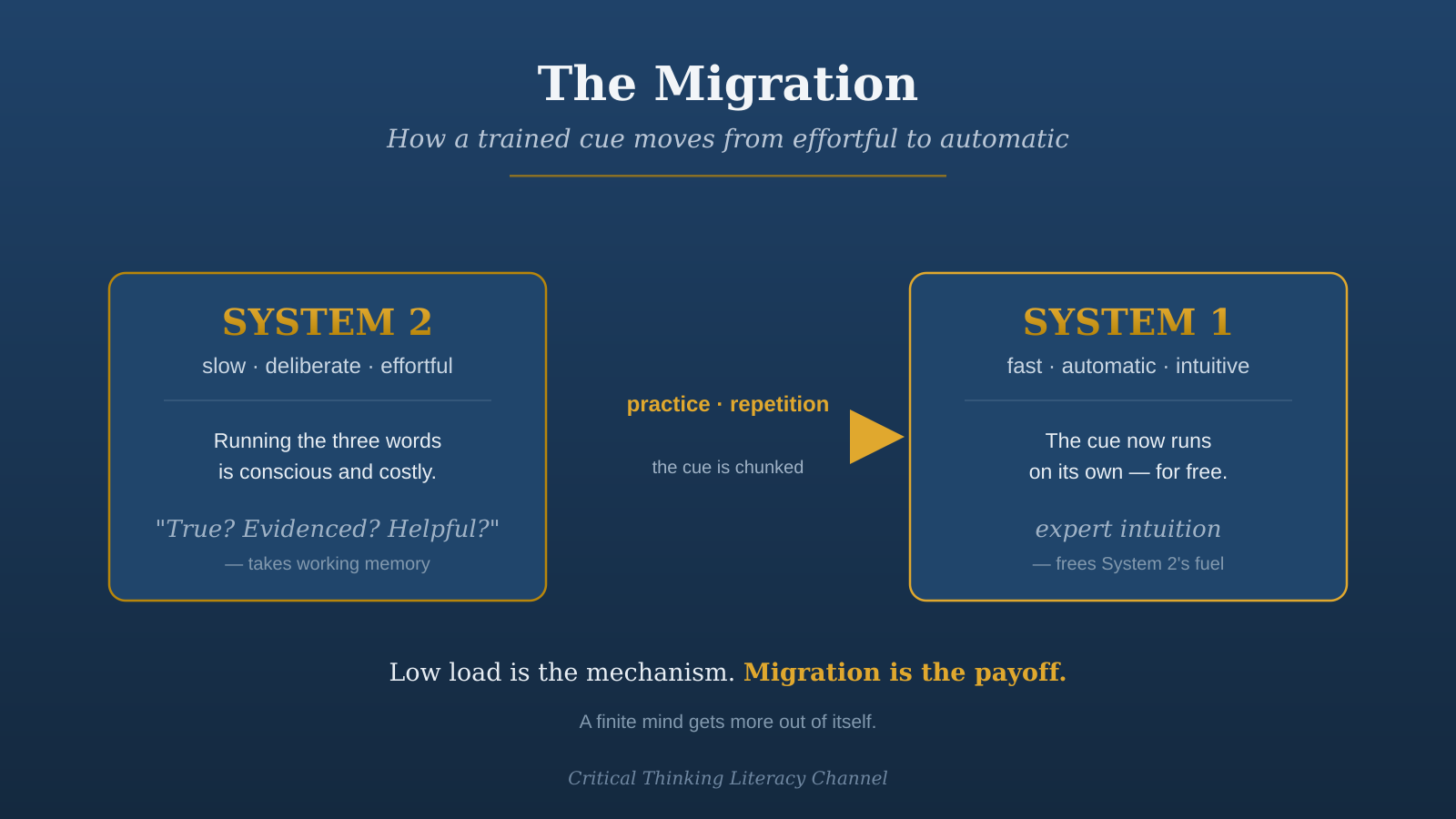
The payoff. Once a cue has gone fluent, it no longer draws on System 2’s limited fuel. That freed capacity can now run a fresh, effortful assessment on a new target. In other words, the Low-Load Migration Method lets a finite mind upgrade its own operating capacity — graduating tools from System 2 into System 1 one at a time, so System 2 is always free for the next hard problem (Balla, 2026a).
This is why no single system label fits the method: it is both at different stages of training. Effortful before practice, intuitive after. The tool migrates; that is a feature of the design, not a flaw in the name.
The Two Application Prompts
The Low-Load Migration Method is the general technique. Aimed at a specific target, it produces a specific three-word cue. Two are in active use:
1. The Belief Prompt — aimed at a claim or a gut feeling:
True? · Evidence? · Helpful?
The Belief cue — three questions, grounded in Ellis’s REBT disputations (Ellis, 1962; Ellis & Dryden, 1997).

When System 1 pitches a feeling as a fact, these three words interrogate it, functioning as an active diagnostic tool to reveal the implicit mental structures that guide your choices (Balla, 2026b). It is a distillation of Albert Ellis’s REBT disputation (see attribution below).
2. The Character Prompt — aimed at a person, especially a leader:
Strength? · Weakness? · Dissent?
How does the person treat strength, weakness, and dissent? People reveal this without being asked, and the three-word cue efficiently captures the reader’s attention (Balla, 2026a).
Both are the same method with different payloads. More applications can be built the same way: pick a target, distill the assessment to three potent words, and train them until the load approaches zero.
In addition, the HALT (hungry, angry, lonely, and tired) acronym, popularized by Alcoholics Anonymous, can be considered a physiological application of the Low-Load Migration Method.
Attribution: The Belief Cue and Ellis’s REBT
Intellectual honesty requires naming the lineage of the Belief Application. Its three questions are a distillation of Albert Ellis’s disputation (the “D” in the ABC(DE) model of Rational Emotive Behavior Therapy), which challenges irrational beliefs on three grounds (Ellis, 1962; Ellis & Dryden, 1997):
Logical — does the conclusion follow? (—> True?)
Empirical — what is the evidence? (—> Evidenced?)
Pragmatic — is holding this belief useful? (—> Helpful?)
What is original here is the formulation — the compression into a fast, trainable three-word cue and its integration into the Low-Load Migration Method — not the underlying disputation criteria, which are Ellis’s. The honest framing: “The Belief cue is my distillation of Albert Ellis’s REBT disputation.”
One Distinction to Keep Clear
Because the method trades on cognitive ease, it must be distinguished from the trap of mistaking ease for truth — the well-documented tendency (which Kahneman links to cognitive ease) to treat whatever is easy to process as more likely to be true (Kahneman, 2011). The distinction, in one sentence:
The Low-Load Migration Method deliberately makes a sound assessment easy to run; the bias runs the other way — being fooled into treating an easy-feeling belief as sound.
One engineer’s ease in the service of rigor; the other is deceived by ease. Drawn well, the method turns cognitive ease into an ally instead of a trap.
The Cognitive Pipeline (Left → Right) Workflow
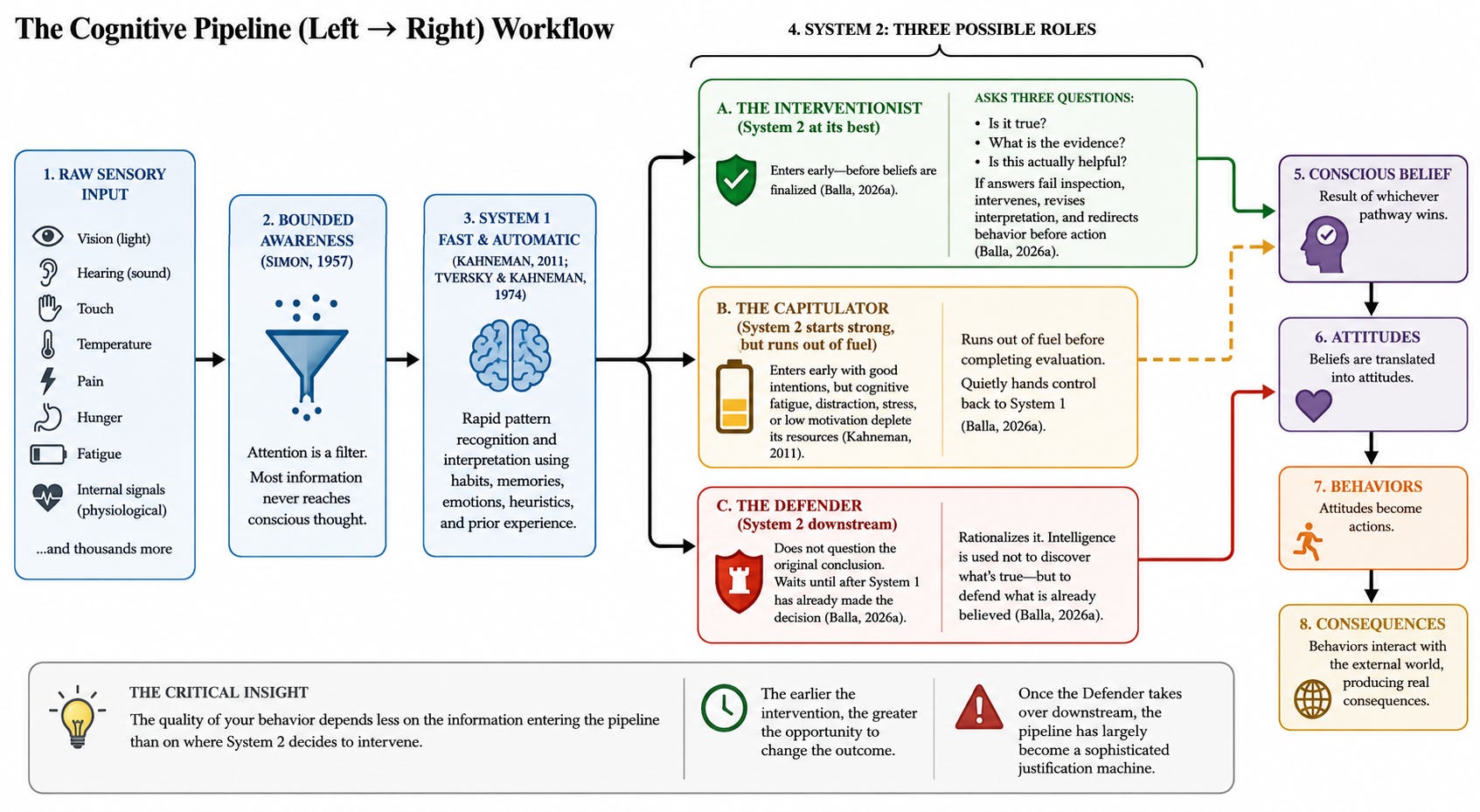
Every decision begins the same way—with raw sensory information entering the cognitive pipeline.
Light enters through your eyes. Sound enters through your ears. Your body contributes touch, pain, temperature, hunger, fatigue, and thousands of internal physiological signals. Before you’re even aware of it, all of this information begins flowing toward consciousness.
The first checkpoint is bounded awareness (Simon, 1957). Your brain simply cannot process everything, so attention acts as a filter. Most information never reaches conscious thought.
Whatever survives that filter is immediately handed to System 1 —your fast, automatic pattern-recognition system. It rapidly constructs an interpretation of reality using habits, memories, emotions, heuristics, and prior experience (Kahneman, 2011; Tversky & Kahneman, 1974).
At this point, System 2 has three possible roles.
The first is The Defender.
The Defender never questions the original conclusion. Instead, it waits until after System 1 has already made the decision. Rather than evaluating the belief, it rationalizes it. Intelligence is used not to discover what’s true—but to defend what is already believed (Balla, 2026a).
The result of whichever pathway wins becomes conscious belief.
That belief is translated into attitudes.
Those attitudes become behaviors.
And those behaviors interact with the external world, producing real consequences.
The critical insight is this:
The quality of your behavior depends less on the information entering the pipeline than on where System 2 decides to intervene.
The earlier the intervention, the greater the opportunity to change the outcome.
Once the Defender takes over downstream, the pipeline has largely become a sophisticated justification machine.
The second is The Interventionist — System 2 at its best.
The Interventionist enters the pipeline early, before beliefs are finalized (Balla, 2026a). It deliberately asks three questions:
Is it true?
What is the evidence?
Is this actually helpful?
If the answers fail inspection, System 2 interrupts the process, revises the interpretation, and redirects behavior before it ever reaches action (Balla, 2026a).
And lastly, The Capitulator.
Here, System 2 begins with good intentions and enters the upstream phase, but cognitive fatigue, distraction, stress, or low motivation deplete its resources. It simply runs out of fuel before finishing the evaluation (Kahneman, 2011). Once depleted, it quietly hands control back to System 1 (Balla, 2026a).
The Framework at a Glance
THE METHOD: The Low-Load Migration Method — an intentional design that lowers System 2’s cognitive load so it actually engages, creating smoother flow between fast and slow thinking (Balla, 2026a).
APPLICATION 1 (Belief Cue): True? · Evidenced? · Helpful? (Balla, 2026a) — distilled from Ellis’s REBT (Ellis, 1962; Ellis & Dryden, 1997).
APPLICATION 2 (Character Cue): Strength? · Weakness? · Dissent? (Balla, 2026a) — distilled from Adorno’s authoritarian personality and Fromm and later Kernberg’s formation of malignant narcissism (Adorno et al., 1950; Marasco, 2022; Fromm, 1964; Kernberg, 1998, 2020).
THE PAYOFF: Trained cues complete their migration (System 2 —> System 1), freeing System 2’s limited fuel for the next hard assessment. This framework also optimizes efficiency within a bounded awareness context: while our cognitive architecture has strict baseline limits, a finite mind can explicitly stretch those boundaries through self-reflection and structured metacognition (Balla, 2025, 2026a).
Until next time, think critically. And choose wisely.
John David Balla, PhD
Chief Content Creator
The Critical Thinking Literacy Channel
References
Balla, J. D. (2026a). The Low-Load Migration Method: An intentional design for defeating System 2 laziness. Substack. https://johnballa546204.substack.com/p/the-low-load-migration-method
Balla, J. D. [Critical Thinking Literacy Channel]. (2026b). 3 questions that expose the beliefs secretly running your life [Video]. YouTube. https://youtu.be/DMLsNKnVfMs?si=GhfQZrHK_V1emAS8
Balla, J. D. (2025). Expanding Bounded Awareness: From Positive Psychology (PsyCap and PERMA) to Positive Decision-Making, and the Role of Self-Reflection in Expanding an Otherwise Bounded Conscious Decision-Making Orthodoxy. [Doctoral dissertation, The Chicago School of Professional Psychology].
Ellis, A. (1962). Reason and emotion in psychotherapy. Lyle Stuart.
Ellis, A., & Dryden, W. (1997). The practice of rational emotive behavior therapy (2nd ed.). Springer Publishing.
Fromm, E. (1964). The heart of man: Its genius for good and evil. Harper & Row.
Kahneman, D. (2011). Thinking, fast and slow. Farrar, Straus and Giroux.
Kahneman, D., & Klein, G. (2009). Conditions for intuitive expertise: A failure to disagree. American Psychologist, 64(6), 515–526. https://doi.org/10.1037/a0016755
Kernberg, O. F. (1998). Ideology, conflict, and leadership in groups and organizations. Yale University Press.
Klein, G. (1998). Sources of power: How people make decisions. MIT Press.
Marasco, R. (2022). The Authoritarian Personality 2.0: Theodor Adorno as a theorist of algorithms. Polity, 54(1), 135–150. https://doi.org/10.1086/717511
Miller, G. A. (1956). The magical number seven, plus or minus two: Some limits on our capacity for processing information. Psychological Review, 63(2), 81–97. https://doi.org/10.1037/h0043158
Simon, H. A. (1957). Models of man: Social and rational. Wiley.
Tversky, A., & Kahneman, D. (1974). Judgment under uncertainty: Heuristics and biases. Science, 185(4157), 1124–1131. https://doi.org/10.1126/science.185.4157.1124
Note on the Belief cue’s lineage: Ellis’s three grounds for disputing irrational beliefs — empirical, logical, and pragmatic — are set out across the works above; the three-word Belief cue (True? / Evidenced? / Helpful?) is a distillation of that disputation, not a restatement of an Ellis-coined phrase.
Note on the Character cue’s lineage: The three criteria for interrogating character or leadership — strength, weakness, dissent — are distilled from Adorno’s authoritarian personality and Fromm and later Kernberg’s formation of malignant narcissism
Note on the HALT cue’s lineage: The HALT (hungry, angry, lonely, and tired) acronym, popularized within the folk wisdom of Alcoholics Anonymous recovery networks, functions as a classic physiological application of the Low-Load Migration Method without a single corporate or academic author.